Tag: energy

  • Tagung Zukünftige Stromnetze 2024

    Tagung Zukünftige Stromnetze 2024

    I was lucky enough to be able to attend the conference on future electricity grids (Tagung Zukünftige Stromnetze) which took place January 24-25, 2024, at Novotel Am Tiergarten, Berlin. It featured speakers from politics, industry, regulatory authorities as well as researchers. It provided many impulses also for our research activities at the DLR-Institute of Networked Energy Systems.

    It is no exaggeration to say that this event is an important annual meeting place for key players in the energy sector with the core topic of the future development of the German electricity grids. Also, a roadmap for the future hydrogen grid was presented by gas transmission operator OGE.

    Some takeaways from the perspective of a grid modeler:

    • As one Tennet representative stressed, we can expect enormous additional demand for reactive power compensation systems due to the shutdown of many conventional power plants, but also due to a generally higher grid load.
    • State Secretary Dr. Philipp Nimmermann announced that reactive power from RE plants would be subject to regulatory treatment still this year, meaning that operators of PV systems will soon be able to provide reactive power to the grid. Next year, privision of spinning reserve will be tackled as well.
    • A TransnetBW representative reminded me that system stability will become an independent planning product.
    • The German regulatory agency (BNetzA) has inspired me to think about future grid modeling principles. One aspect is that loads will no longer be fixed but mostly be controllable in the future. What is the most practical way to represent such flexible loads in large-scale grid models?
    • Also the resilience of our future energy system was addressed: What is the right social compromise between security of supply and inferred infrastructure costs? I personally think we could very well live with a slightly higher SAIDI here in Germany which stands very well in international comparison, as long as it keeps the costs of the energy transition manageable.

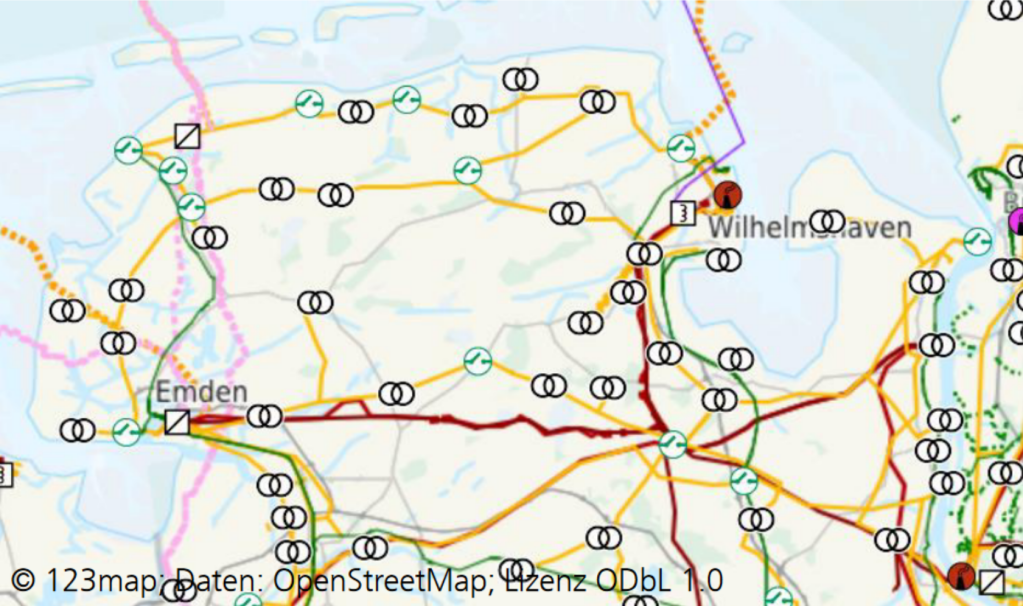
    In our own contribution (poster and proceedings), we reported from our progress in evaluating and developing model coupling methods and applying them to realistic models for the future electricity and hydrogen grids of Northwest Germany. To start off, we have implemented a coupled power-hydrogen test system with the Python-based tools PyPSA, PandaPower and PandaPipes.

    One objective of our preliminary work done last year was to get an overview of which grid models (test systems and models of real grids) exist and which coupling methods are used. We also identified a lack of integrated electricity-gas test systems. The publication of a validated coupled hydrogen-electricity test system could become a secondary objective of our ongoing work.
    I can recommend the conference for all who want to stay up-to-date with the energy transition in Germany or establish new contacts within the electricity sector. We are generally represented by at least one colleague each year.
  • The European natural gas system through the lens of data platforms

    The European natural gas system through the lens of data platforms

    Finally, after two years of work, we finished our paper on the ENTSOG and GIE transparency platforms! Always good to get things done, especially after endeavors such as writing a full-length article for a scientific journal.

    What is it about?

    Crosslink to corresponding LinkedIn post: The European natural gas system through the lens of data platforms

    The ENTSOG Transparency Platform (TP) and the GIE transparency initiatives AGSI+ and ALSI have evolved into indispensable data resources for numerous public and private entities. They provide key indicators on natural gas transport, regasification and storage with noteworthy temporal resolution on a per facility/cross-border interconnector basis.

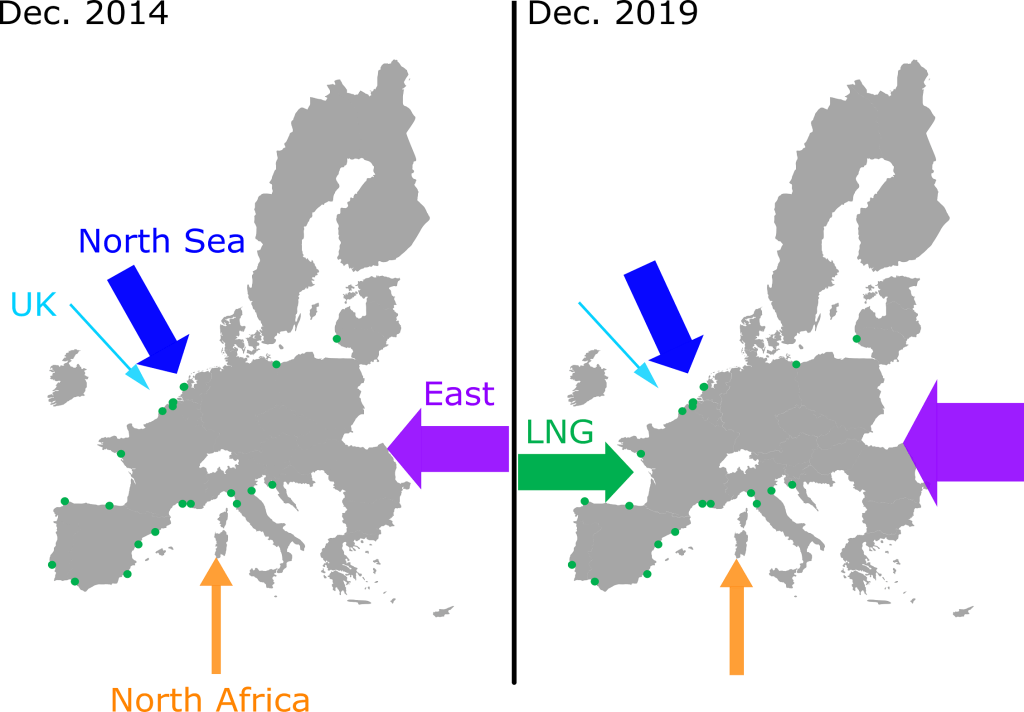
    In this paper, we highlight the significance of leveraging ENTSOG and GIE TP data to monitor the European Union’s security of gas supply. We demonstrate how the use of Europe’s gas pipeline network has changed over time, with the most profound transformations observed in 2022. Geopolitical events, specifically Russia’s aggression against Ukraine, prompted a reversal of traditional flow patterns from East to West, resulting in entirely new operational regimes in certain network areas. Additionally, our analysis unveils several other intriguing developments that unfolded in the years before.

    Inflow along major pipeline corridors and from LNG terminals into the EU and EU-indigenous production: Comparison between December 2014 and December 2019.
    Inflow along major pipeline corridors and from LNG terminals into the EU and EU-indigenous production: Comparison between December 2014 and December 2019.

    We also address the evolving usage patterns of LNG terminals and underground storage (UGS) facilities. Notably, existing LNG terminals saw unprecedented utilization factors starting from 2022, and the continent’s regasification capacity continues its upward trajectory. Intriguing developments have also emerged in the EU’s gas storage sector, particularly concerning EU storage capacity previously held by Gazprom, displaying unusual behavior as early as 2021. As Europe transitions from dependence on Russian gas to alternative sources, primarily LNG, the task of replenishing gas storages before winter has presented a considerable challenge.

    Proposing additional investigations into alternative indicators offered by the platforms, such as capacity and consumption, it is anticipated that the transparency platforms of ENTSOG and GIE will undergo further enhancements in the future, elevating its usefulness for policy makers, practitioners, and researchers alike.

    Methodology

    The technology behind this study shall not be discussed in detail at this point, it deserves a blog post of its own. We have developed the Python library eurogastp which facilitates downloading and processing data from the ENTSOG and GIE transparency platforms. In the case of the ENTSOG TP, the package does not only help with merely downloading the data, but also with further processing it, which makes it stand out compared to other libraries. Eventually, the data is provided in Pandas DataFrames where the data can easily be filtered, aggregated and visualized.

    Acknowledgements

    I am grateful for the support and collaboration of my colleagues Jean-François Vuillaume, Ricardo Fernández-Blanco Carramolino, Hugo Calisto, Nuria Rodríguez Gomez and Ricardo Bolado Lavin without whom this work would not have been possible. I would also like to thank Rebecca Schill who helped us with the language editing.

    How to Cite

    Jung, D., Vuillaume, J. F., Fernández-Blanco, R., Calisto, H., Gómez, N. R., & Lavín, R. B., The European natural gas system through the lens of data platforms. Energy Strategy Reviews, 51 (2024), 101297; https://doi.org/10.1016/j.esr.2024.101297.